 a 3-D copper-foil construct with sides in degussa enamel, lustre painting, stencil sandblasting, engraving and lamp-worked beads. It's OK, but not exactly my 'thing'.
I welcome now having a few weeks to think about what I have learned so far and where I want to go from here. We have been running hard to catch up with all the different techniques we have been learning, so reflection time has been scant.
However, there's the Festive Season to get through first. And will I or won't I do a glass-themed Christmas card? [Afternote: Reader, I did -- shaped like this box.]


 An interesting afternoon in the workshop and then to Broadfield House to look at and talk about the techniques of cameo glass. I don't think I want to go down the
  We had an impressive afternoon’s demonstration on pulling canes, making twisted canes, rods for millefiore and murrine by two stalwart French girls. At one point, one gathered up a line of clear and white rods, fixed and twisted them on the marver, and then blew a beautiful tumbler. I asked if I could buy it but it broke as she cracked it off – the punty was apparently too hot. Someone said, ‘make one yourself’, but honestly I don’t think I will ever be able to do that. Two days later we watched again as they made a large plate and a large vase using the canes and tiles. Very impressive, but I felt they overworked the pieces and that they would have been more pleasing had they halted earlier in the process.


 This is a complex series of processes that involves making some clay tiles with textures and patterns indented in them. Then clamping them within boards into which you pour a mixture of plaster and molochite. When this has set, you take out the clay, clean up the mould and clean the floor (which is very messy by then). You then take home some glass cullet - looks a bit like washing soda crystals - wash it and sieve it through three different sieves to get a coarse one (like large sugar crystals), medium (like granulated sugar) and ideally a fine one like caster sugar. But few students have a pestle and mortar in their digs, so I haven't achieved that one. My tiles (one pictured)are waiting now for the next stage which is to add colour and fire each one at a different setting.
 To what extent does this slumped plate by Liz Lowe (at the V&A) start out as a meticulous design and how much does it grow organically? I have been thinking all week about designing as you make something rather than knowing beforehand what you are going to do. I feel there is room for both approaches. I tend to adapt all the time as I go along -- rather like a musician does in interpreting a score. The college ethic seems to be to be able to show and document all your thinking processes. It's not so linear for me. Sometimes you go in seemingly aimless spirals, and arrive at a place you might not get to with step-by-step thinking.

 I spent hours in the glass gallery at the V&A looking closely at modern and more recent glass -- not my old favourites, the 18th century twists. Took some photos and made drawings and notes. Lots of ideas to take further. I also watched all the videos on the touch screens. They're quite good. I learned a great deal about technique -- not more than by watching the real thing, of course, but they did fill in a lot of gaps of understanding. Then I went to the library http://www.vam.ac.uk/nal/ and made a favpurites list of periodicals and books to look at next time. It's a better collection than the Harrison Learning Centre.

 Today we learned how to calculate the weight of raw materials needed for a batch of glass and the percentage of metal oxides – sand (silica) being, of course the central ingredient with other compounds (e.g. lead, soda ash, borosilicate, etc) varying the consistency and brightness. I found this strangely compelling, though the chances of my needing to do it myself are slim. At £600 a ton of molten glass, I am unlikely to need to make up a batch. Took me back to chemistry at school.
 We used our design session for a trip to the Harrison Learning Centre at Wolverhampton University to browse through its collection of books and journals on glass. Fairly inspiring and generally useful, but I thought it cut into studio time a bit too much. There's quite little usable time when you can get in to a workshop continue a project -- if you are like me and need to feel unconstrained by time.
 I made 7 beads(pictured) of which 3 wouldn't come off the mandrel. I look forward to going on with this -- lots of possibilities here.

 I've rather enjoyed having my own space and making it look nice without having to negotiate with anyone else. At first, I was going to keep the white walls empty, but I can't seem to do that. Acquisition creep has crrept.
 This is me in the hot shop, looking surprisingly convincing (considering I can't do it). But look at that red hot bit of glass at the end of the iron (not a bad gather) and look at the angle of my pucella (that's the pincery thing) which is OK. I ruined it after that by blowing too much, natch. But you learn from mistakes.
 And here is my first -- what shall I call it -- um, vessel. It looks better in this picture than it actually is. Ashtray sized. I hope I will be horribly ashamed of it in a few weeks, but just now I do admit to being a little bit chuffed. Even this, wobbly though it is, is quite hard to achieve.
 Two features of week 6. First, learning to play about in photoshop. This is an image I painted with various brushes and then put through various filters and distortions. This could be worked on to make a stained glass window. I have now begun a first bit of copper-foil work, which is growing organically and will be ready to photograph next week.
 The other was using this Photoshopped design for Degusse enamelling -- so far I have only done the black lining and stippling firings, but am thoroughly enjoying it -- and then the same design for trying out different depths of sand-blasting. Not quite so successful, but I do see the potential of this technique.
 Our 'model' here is the artist Cappy Thompson from whose site this picture comes. Big bold stuff that this vignette doesn't do justice to. We have started by painting in the black outlines ready for adding colour next week. A very happy morning spent playing about with this technique (and also catching up on my tones and lustre pieces). Three of us then spent the afternoon in the kiln room continuing our work. Hope we can manage that every Thursday. I started some experimental bits with a view to trying out copper-foiling.
 However, on the accommodation front, I am feeling more upbeat as I have moved into a self-contained flat with white walls and wooden flooring and I think I can make it quite nice and somewhere I can do some work in the evenings -- what though it is in Brierley High Street, next door to a take-away and opposite a bingo hall. Picture is retrospective as I can only post them up at weekends when I am at home, and this one shows my first 'light-catcher' (very badly made with the bingo hall in view).
 This is the first stage of my first bit of glass painting; picking out the dark lines from a Degas mezzotint with a black glaze and fired once ready for the half tones and stippling effects. I've photographed it and experimented with tones and silver oxide (yellow) possiblities in Photoshop. It will probably be quite different in the end.
 We've also had a bash at painting with lustres (very expensive) and that's in the kiln as we speak. Here's a pic I took last weekend when we went to Blackwells on Lake Windermere and I saw these vases by Loetz. Don't like them much, but I enjoyed the lustre session.
 Specialises in sculptural melted glass forms drawn from nature.
 transparent, translucent, crystal-clear, see-through, lustrous, vitreous, gleaming, glinting, sparkle, spangle, glisten, shine, reflective, refractive, magnify, irridescent, brilliant, prismic, glassy stare, icy, watery, pellucid, frosted, filmy, screen, filter, pane, opaque, cloudy, crizzled, crazed, fragile, shattering, shatter-proof, brittle, sharp, shattered, jagged, splinter, shard, polished, burnished, glazed, glacé, toughened, exclusion, inclusion, facetted, fissile, cut, conductive, liquid, solid, fractured, ductile
 It's in the spirit of a blog to log other sites of interest, so here goes. Might as well nick some pictures off them as well.
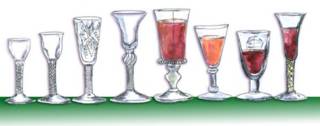


 I am packed, and ready to go up to Brierley Hill (part of Dudley College) in the Midlands for a full-time course in the Techniques and Technology of Glass at the International Glass Centre. It starts on Monday. I'll be learning glass blowing, enamelling, stained glass, painting, engraving and I don't know what else. It's going back to a previous me -- the artistic side -- that I have not fully explored and I feel time is running short. It isn't as huge a leap into the dark as it might sound -- I have been thinking a lot about 'glass pages' and about interactivitiy and creativity. In the back of my mind are some connections between writing, glass and technology that I want to think about. I am fortunate to get an EU-funded place, but if this goes anywhere further I shall be looking out for some sort of grant or residency.